Standing in the lawn mower aisle — or scrolling through dozens of online listings — can feel completely overwhelming. There are push mowers, self-propelled mowers, riding tractors, and zero turn mowers, each with a dizzying array of engine sizes, cutting decks, and price tags. So how do you know which one is actually right for your yard?
The good news: choosing the right lawn mower doesn’t have to be complicated. In this guide, we’ll break down every key factor you need to consider — yard size, terrain, features, and budget — so you can make a confident, informed decision that saves you time, money, and frustration for years to come.
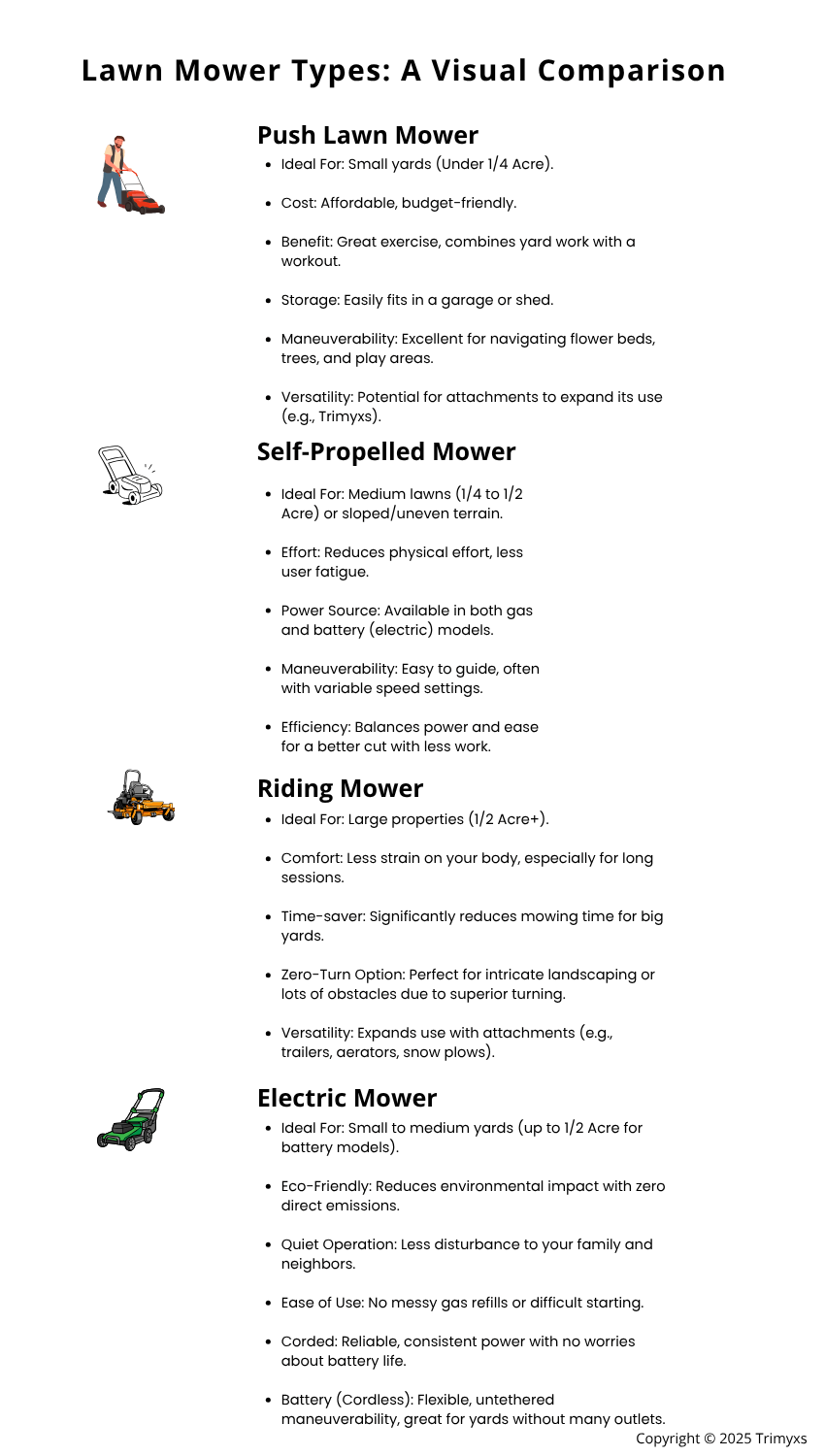
Know Your Yard’s Size and Layout
The single most important factor in choosing a lawn mower is the size of the area you need to mow. Everything else — engine power, cutting width, riding vs. walking — follows from this one number. Not sure of your exact square footage? You can break irregular lawns into rectangles, measure each section separately, and add them up — or use a satellite measurement tool for an instant result.
Under ¼ Acre: Push or Self-Propelled Walk-Behind Mower
For small yards under a quarter acre, a quality walk-behind mower is all you need. Battery-powered walk-behinds are a particularly strong fit here — Consumer Reports testing found that the average cordless walk-behind delivers 45 to 50 minutes of runtime per charge, which is more than enough for a quarter-acre lot. A basic push mower works fine for flat terrain, while a self-propelled model is worth the upgrade if you have even slight slopes. These mowers are affordable, easy to store, and simple to maintain.

¼ to ½ Acre: Self-Propelled or Entry-Level Riding Mower
In this range, a self-propelled walk-behind is still manageable, but mowing starts to take a significant chunk of your time. Many homeowners in this size range opt for a small riding mower or garden tractor to cut that time in half. Front-wheel-drive self-propelled models are easier to maneuver around obstacles, while rear-wheel-drive handles slopes with better traction — worth considering if your yard is anything but flat.
½ to 1 Acre: Riding Mower or Lawn Tractor
Once you’re above half an acre, a riding mower or lawn tractor becomes the practical choice. A riding mower with a 42- to 46-inch cutting deck can cover this amount of lawn in under an hour, depending on obstacles and complexity. Lawn tractors also accept attachments like baggers, carts, snow blades, and aerators — making them a workhorse beyond mowing season.
1 Acre and Above: Zero Turn Mower
For anything over an acre — especially larger, flatter lawns — a zero turn mower is the gold standard. Zero turns are dramatically faster than traditional lawn tractors, thanks to their ability to spin on a dime and eliminate the wide turning arcs that waste time. Independent testing has shown that zero turn mowers can be roughly 40% faster than lawn tractors over the same ground. We’ve put together extensive zero turn lawn tractor reviews to help you find the best model for large properties.
| Yard Size | Recommended Mower Type | Typical Deck Width |
|---|---|---|
| Under ¼ acre | Push or self-propelled walk-behind | 18–21 in |
| ¼ – ½ acre | Self-propelled or small riding mower | 21–42 in |
| ½ – 1 acre | Riding mower or lawn tractor | 42–46 in |
| 1 – 3 acres | Zero turn mower (residential) | 42–54 in |
| 3+ acres | Zero turn mower (commercial-grade) | 54–72 in |
Evaluate Your Terrain
Yard size tells you the mower’s capacity requirement — but terrain tells you the type of mower you can safely and effectively use. This step is critically important and one that many buyers overlook until they’re already stuck on a hill with the wrong machine.
Flat, Open Lawns
Flat, obstacle-free yards are where zero turn mowers truly shine. Their speed and maneuverability make mowing a large, flat lawn surprisingly quick and satisfying. If your yard fits this description, a zero turn is probably your best investment.
Sloped or Hilly Terrain
This is where mower choice becomes a genuine safety issue. Standard lap-bar zero turn mowers are not ideal for steep slopes — OSHA recommends against using them on inclines steeper than 15 degrees, and their rear-wheel drive system can lose traction on wet grass even at shallower angles. For hilly properties, a traditional lawn tractor with a lower center of gravity is the safer choice. That said, newer steering-wheel zero turns with four-wheel control systems offer meaningfully better hill performance than the traditional lap-bar design — handling slopes up to 20 degrees safely in dry conditions according to independent testing.
Read our detailed comparison of zero turn vs lawn tractor to understand which handles hills better for your specific property.
Tight Spaces with Obstacles
If your yard has lots of trees, garden beds, or tight corners, a zero turn’s precise steering becomes a major advantage. It can navigate around obstacles without the constant back-and-forth passes that cost time — and without the trimmer follow-up work that a wider-turning tractor requires around every bed edge.
Rough or Uneven Ground
For rough terrain with ruts, roots, or uneven patches, look for mowers with larger rear wheels and adjustable cutting height. Some heavy-duty zero turn models also feature suspension seats that significantly reduce operator fatigue on bumpy ground.
Understand the Main Types of Lawn Mowers
Walk-Behind Push Mowers
The simplest and most affordable option. Available in gas, electric corded, and battery-powered versions. Best for small, flat yards under ¼ acre where budget is a priority. Manual reel mowers — fully human-powered with scissor-action blades — are also worth considering for tiny lawns under ⅛ acre; they’re whisper-quiet, emission-free, and cost as little as $100–$250.
Self-Propelled Walk-Behind Mowers
The mower’s engine drives the wheels, reducing effort on hills and larger yards. Front-wheel drive handles flat terrain with lots of tight turns; rear-wheel drive performs better on slopes and open ground. Self-propelled models typically cover up to ¾ acre comfortably. If you find yourself mowing a large yard and your arms are doing all the work, this upgrade pays for itself in the first season.
Riding Lawn Mowers
Traditional riding mowers with a steering wheel and a front- or mid-mounted cutting deck. Excellent for ½ to 2-acre properties with moderate complexity. Usually more affordable than zero turn models but slower, and their wider turning radius means more trimmer cleanup around obstacles. Gas mowers rule this category, but battery-powered riding options are improving — a few models now deliver nearly 2 hours of runtime per charge.
Lawn Tractors
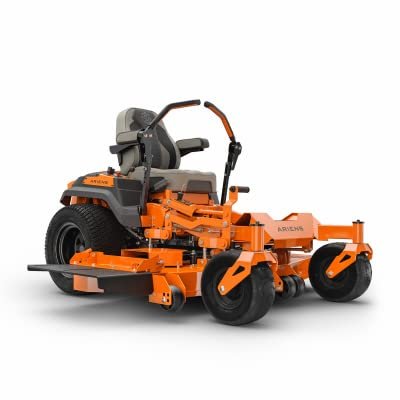
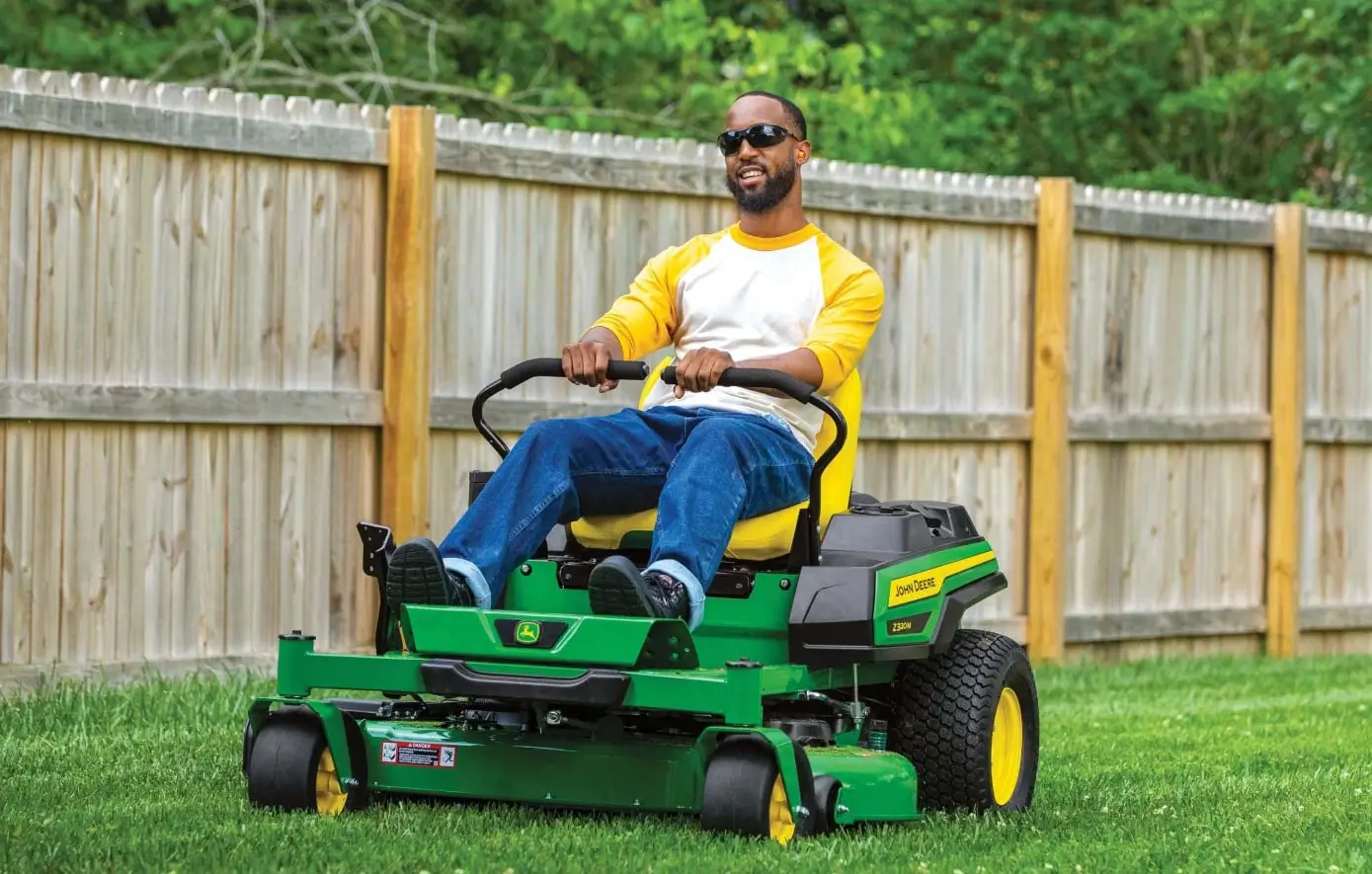
Essentially a more powerful version of a riding mower, lawn tractors can accept attachments like baggers, carts, snow blades, and aerators. If you want a mower that doubles as a workhorse for other yard tasks throughout the year, a lawn tractor makes a compelling case. Check out our detailed Ariens 991163 Apex zero turn lawn tractor review to see how one of the top models performs in real-world conditions.
Zero Turn Mowers
The fastest, most maneuverable option for large properties. Controlled by two lap bars or a steering wheel (on newer residential models), zero turns allow you to spin on a dime and stripe your lawn with precision. They’re the preferred choice for professional landscapers and serious homeowners with 1+ acres to maintain. The trade-off: limited attachment versatility and reduced stability on steep slopes compared to a conventional tractor.
Also worth mentioning: robotic mowers are a growing category, with most residential models priced between $500 and $2,500. They work autonomously within a perimeter you define and are ideal for lawns that are mowed frequently — though their narrow cutting decks (often around 9 inches) mean they work best as a maintenance tool rather than a catch-up tool after tall growth.
Cutting Deck Size — How Wide Should You Go?
The cutting deck is the width of the mowing path your mower makes in a single pass. A wider deck covers more ground per pass, which means fewer passes and faster mowing times — but also a larger mower that’s harder to store and maneuver in tight spaces.
- 18–21 inches: Walk-behind mowers. Best for small lawns with tight gates and narrow areas.
- 30–42 inches: Entry-level riding mowers and lawn tractors. Good for ½ to 1 acre.
- 42–54 inches: Mid-range zero turn and riding mowers. Ideal for 1 to 3 acres.
- 54–72 inches: Commercial and high-end residential zero turn mowers. Designed for large properties of 3+ acres.
A practical rule of thumb: if you have a gate that mower must pass through, measure it before you shop. Walk-behind models at 21 inches fit nearly any gate; a 54-inch zero turn will not.
Gas, Battery, or Electric — Which Power Source Is Right?
Gas-Powered Mowers
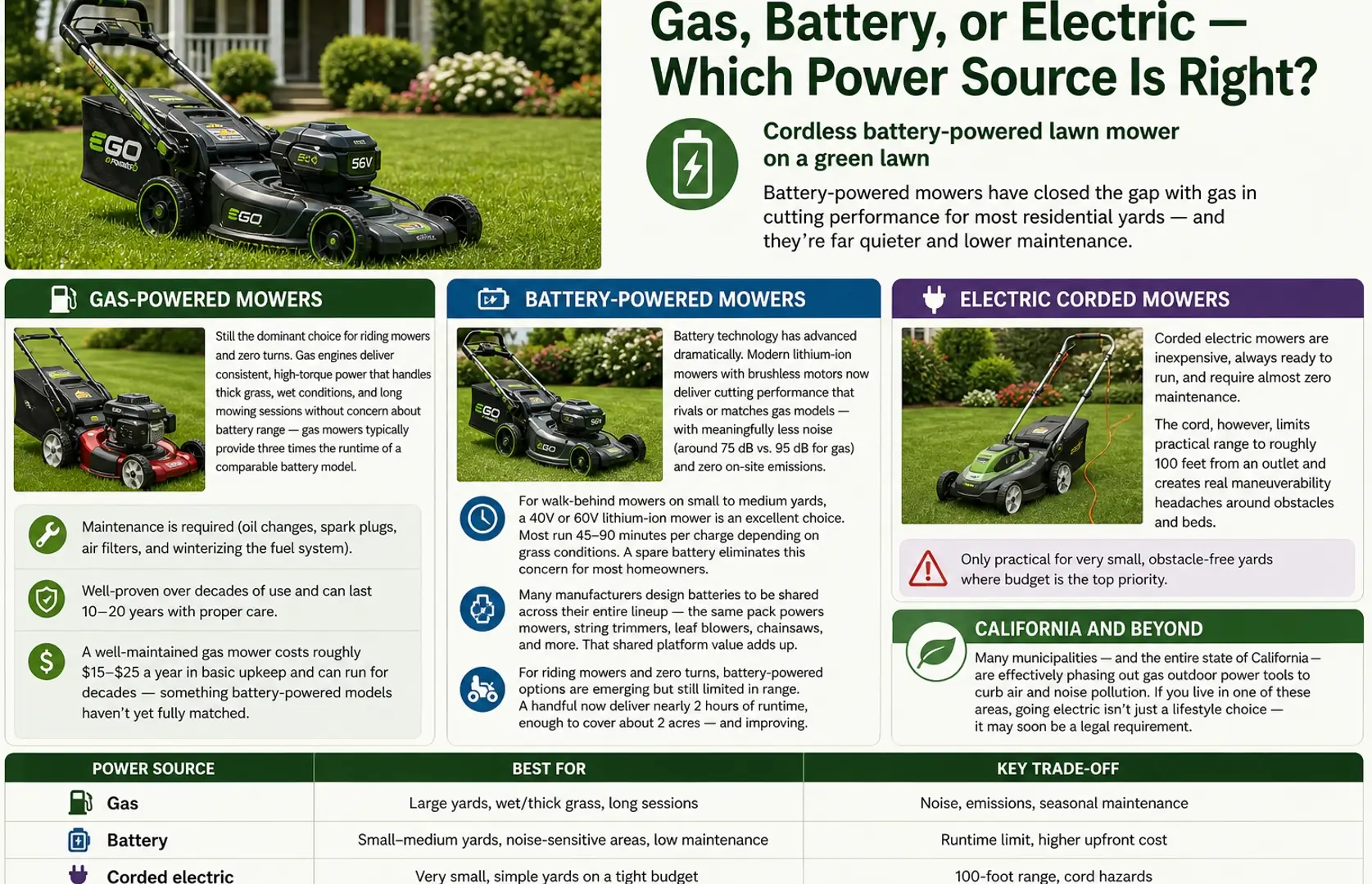
Still the dominant choice for riding mowers and zero turns. Gas engines deliver consistent, high-torque power that handles thick grass, wet conditions, and long mowing sessions without concern about battery range — gas mowers typically provide three times the runtime of a comparable battery model. Maintenance is required (oil changes, spark plugs, air filters, and winterizing the fuel system), but gas mowers are well-proven over decades of use and can last 10–20 years with proper care. A well-maintained gas mower costs roughly $15–$25 a year in basic upkeep and can run for decades — something battery-powered models haven’t yet fully matched.
Battery-Powered Mowers
Battery technology has advanced dramatically. Modern lithium-ion mowers with brushless motors now deliver cutting performance that rivals or matches gas models in Consumer Reports’ side-by-side tests — with meaningfully less noise (around 75 dB vs. 95 dB for gas) and zero on-site emissions. For walk-behind mowers on small to medium yards, a 40V or 60V lithium-ion battery mower is a genuinely excellent choice. The primary trade-off is runtime: most battery walk-behinds run 45–90 minutes per charge depending on grass conditions. Owning a spare battery eliminates this concern for most homeowners.
One significant bonus: many manufacturers design their batteries to be shared across their entire lineup of outdoor tools — the same pack that runs the mower can power your string trimmer, leaf blower, or chainsaw. That shared platform value adds up quickly.
For riding mowers and zero turns, battery-powered options are emerging but still limited in range compared to gas. A handful of electric riding mowers now deliver nearly 2 hours of runtime on a charge, enough to cover about 2 acres — a figure that will only improve as the technology matures.
Electric Corded Mowers
Corded electric mowers are inexpensive, always ready to run, and require almost zero maintenance. The cord, however, limits practical range to roughly 100 feet from an outlet and creates real maneuverability headaches around obstacles and beds. Only practical for very small, obstacle-free yards where budget is the top priority.
| Power Source | Best For | Key Trade-off |
|---|---|---|
| Gas | Large yards, wet/thick grass, long sessions | Noise, emissions, seasonal maintenance |
| Battery | Small–medium yards, noise-sensitive areas, low maintenance | Runtime limit, higher upfront cost |
| Corded electric | Very small, simple yards on a tight budget | 100-foot range, cord hazards |
Key Features to Look For
Once you’ve narrowed down your mower type and power source, these features separate a good machine from a great one:
- Adjustable cutting height: Look for at least 5–7 height settings, ranging from 1.5 to 4 inches. A single-lever height adjustment (raising all four wheels simultaneously) is a genuinely useful quality-of-life feature worth paying for.
- Mulching, bagging, and side discharge: Versatile mowers that handle all three give you the most flexibility across seasons. Mulching returns finely cut clippings to the lawn as a natural fertilizer — an underrated benefit that reduces fertilizer needs.
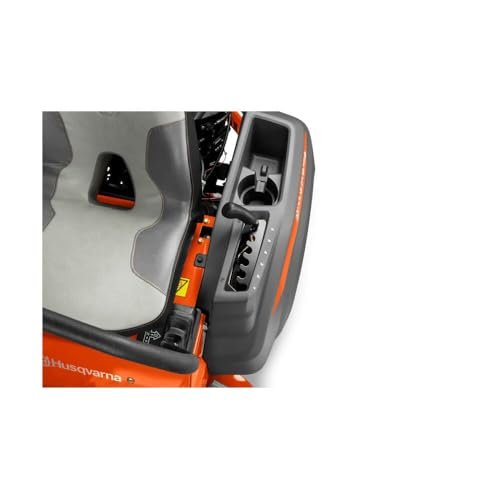
- Comfortable seat and ergonomics: On riding and zero turn mowers, you may spend 1–3 hours on this seat every week. A suspension seat makes a meaningful difference on rough terrain. Test the seating position before you buy if possible.
- Electric blade engagement (PTO): Smoother than manual belt-driven systems and requires less maintenance. Worth prioritizing on mid-range and above models.
- Fuel tank size: For large properties, a larger fuel tank means fewer interruptions to refuel. Some commercial-grade zero turns carry enough fuel for several continuous acres of mowing.
- Interchangeable batteries: If you’re going cordless, check whether the battery is compatible with other tools from the same brand. That compatibility can substantially improve the value of your purchase.
- Brushless motor (battery models): Brushless motors run cooler, more efficiently, and last longer than brushed alternatives. They’re now the standard on quality battery-powered mowers and worth seeking out.
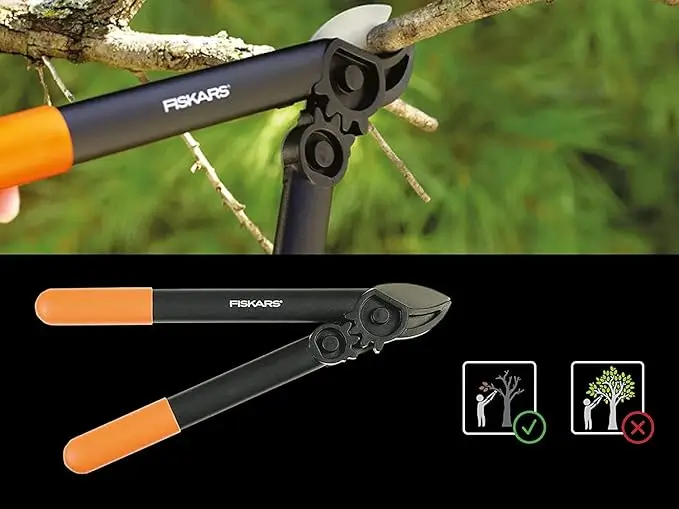
One more thing most guides skip: good lawn maintenance doesn’t stop at mowing. How you trim, edge, and care for your plants around the lawn matters enormously for the final result. Our in-depth guide on how to prune plants correctly covers the techniques that keep your garden beds looking sharp alongside a freshly cut lawn — including how to avoid the most common mistakes that damage shrubs and trees year after year.
Set Your Budget Realistically
Mower prices span a very wide range, and the jump from one category to the next is significant. Here’s a realistic breakdown of what to expect in 2025–2026:
| Mower Type | Typical Price Range | Budget Tier |
|---|---|---|
| Walk-behind push mower | $200 – $500 | Accessible |
| Self-propelled walk-behind | $350 – $800 | Accessible |
| Entry-level riding mower | $1,000 – $2,000 | Mid-range |
| Mid-range lawn tractor | $2,000 – $3,500 | Mid-range |
| Zero turn mower (residential) | $2,500 – $5,000+ | Mid-range |
| Zero turn mower (commercial-grade) | $5,000 – $12,000+ | Premium |
When setting your budget, consider the long-term cost of ownership, not just the sticker price. A reliable, well-made mower that lasts 10–15 years with proper maintenance is almost always a better value than a cheaper model that needs frequent repairs. Electric mowers cost around 30 cents per “fill-up” (a full battery charge) versus $3–$5 for a tank of gas — over ten years, that difference accumulates into real money. Read our zero turn lawn tractor reviews for real-world performance data that helps you spend wisely.
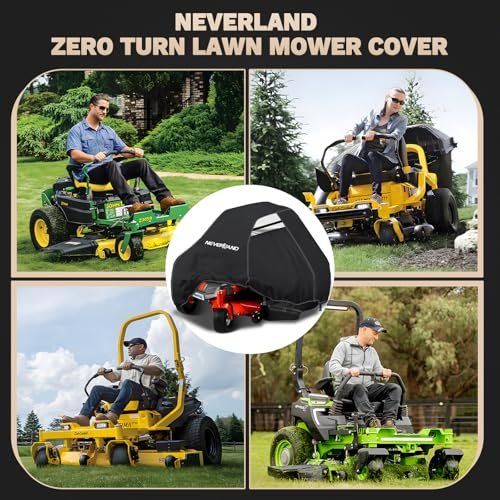
“Don’t forget that protecting your investment is part of the cost of ownership. After you buy your mower, a high-quality zero turn mower cover will shield it from UV damage, rain, and debris — extending the life of your machine significantly.”
Final Thoughts
Choosing the right lawn mower comes down to four key factors: your yard’s size, your terrain, your preferred power source, and your budget. Use this guide as your framework, match each factor to the right mower type, and you’ll end up with a machine that makes mowing genuinely enjoyable rather than a chore.
And remember — a great-looking lawn is about more than just the cut. Once you’ve handled the mowing, the plants and shrubs around your yard deserve the same attention. Our complete guide on how to prune plants correctly will help you avoid the most damaging mistakes — like flush cuts, stubs, and lion-tailing — that shorten the life of your trees and shrubs.
For side-by-side analysis of top mower models, don’t miss our full zero turn vs lawn tractor breakdown — it’s one of the most practical comparisons on the site.