If you’ve ever stood in your garden staring at an overgrown shrub wondering, “Where do I even start?” — you’re not alone. Pruning is one of those gardening tasks that sounds complicated, feels risky, and gets put off season after season. But here’s the truth: pruning is one of the most forgiving and rewarding skills you can develop as a gardener.
Most healthy plants bounce back quickly from a well-intentioned trim. The real damage comes from not pruning at all — or from using the wrong tool and making the wrong cut. In this complete guide, we’ll break down everything: what pruning actually is, why it matters, when to do it for every major plant type, which tools to reach for, and exactly how to make each cut for maximum plant health.
What Is Pruning — And Why Does It Actually Work?
Pruning is the deliberate, selective removal of parts of a plant — branches, stems, buds, leaves, or roots — to improve its health, appearance, safety, or productivity. While it can apply to any plant, pruning is most commonly performed on trees, shrubs, roses, fruit trees, hedges, and vines.
The science behind why pruning works is genuinely fascinating. The growing tip of every stem contains a bud called the apical bud, which produces hormones called auxins. These auxins travel down the stem and actively suppress the lower buds from growing — a phenomenon called apical dominance. When you prune off the apical tip, that hormonal suppression is removed, and the lower buds are suddenly free to develop into new branches. This is exactly why trimming the tips of a leggy plant makes it bushy and full, rather than just shorter.
Understanding this principle changes how you approach every pruning decision. You’re not just tidying up — you’re actively steering how and where your plant grows.
Key Benefits of Pruning Your Plants
Regular pruning pays dividends across every area of your garden’s performance. Here’s what you’re working toward with every cut:
- Promotes vigorous new growth: Removing old, unproductive wood redirects the plant’s energy toward fresh, strong shoots. This is why roses pruned in late winter explode with new growth in spring.
- Improves plant health: Dead and diseased wood is a reservoir for pathogens and pest colonies. Removing it early stops problems from spreading to healthy tissue.
- Increases airflow and sunlight: A dense, crowded canopy creates the humid, shaded microenvironment that fungi love. Thinning the canopy dramatically reduces the risk of powdery mildew, black spot, and other common diseases.
- Boosts flower and fruit production: For most flowering shrubs and fruit trees, regular pruning stimulates the type of growth that actually produces blooms and fruit — not just leaves.
- Controls size and shape: Without pruning, many shrubs and trees eventually outgrow their space, crowding structures, blocking light, or encroaching on pathways.
- Removes hazards: Dead, crossing, or structurally weak branches can fail in storms. Identifying and removing them early is basic property safety.
- Extends plant lifespan: Plants that are regularly pruned and maintained simply live longer than those left completely unmanaged. Proper pruning removes the stressed wood that would otherwise become a point of structural failure.
Worth knowing: Studies from university horticulture departments consistently show that plants with well-maintained canopies are 30–40% less likely to suffer from fungal disease infections compared to densely overgrown specimens of the same species.
Essential Pruning Tools (And When to Use Each)
The most common pruning mistake isn’t a bad cut — it’s using the wrong tool for the job. Forcing pruning shears through a thick branch damages both the tool and the plant. Here’s the complete toolkit:
| Tool | Best For | Branch Diameter | Notes |
|---|---|---|---|
| Hand Pruners (Bypass) | Live, green stems; roses; soft woody shrubs | Up to ¾ inch | Best all-around choice for healthy live wood |
| Hand Pruners (Anvil) | Dead wood; dry, woody stems | Up to ¾ inch | Crushes live wood — avoid on healthy plants |
| Loppers (Bypass) | Medium branches; overhead reach | ¾ inch – 2 inch | Extended handles give needed leverage |
| Hedge Shears | Hedges; topiary; large surface shaping | Up to ½ inch | Not for structural cuts — surface shaping only |
| Pruning Saw | Thick branches; tree limbs | 2 inches and above | Curved blade; cuts on pull stroke |
| Pole Pruner / Pole Saw | High branches; overhead work from ground | Up to 1.5 inch (pruner head) | Keeps feet safely on ground; 8–16 ft reach |
Bypass vs. Anvil Pruners — Which Should You Choose?
This is the most common tool question beginner gardeners ask. The short answer: reach for a bypass pruner for almost every garden task involving live, healthy plants. Bypass blades pass each other like scissors, creating a sharp, clean slice that heals quickly. Anvil pruners press a single blade down onto a flat plate — this action crushes soft tissue and leaves a ragged wound that takes significantly longer to close.
Anvil pruners do have a place: they’re excellent for cutting dead or very dry woody material, and their simpler mechanism means they tend to be more durable under heavy use. But for the majority of gardeners doing the majority of pruning tasks, bypass is the go-to. If you want a breakdown of every difference, head to our detailed comparison of bypass pruner vs anvil pruner.
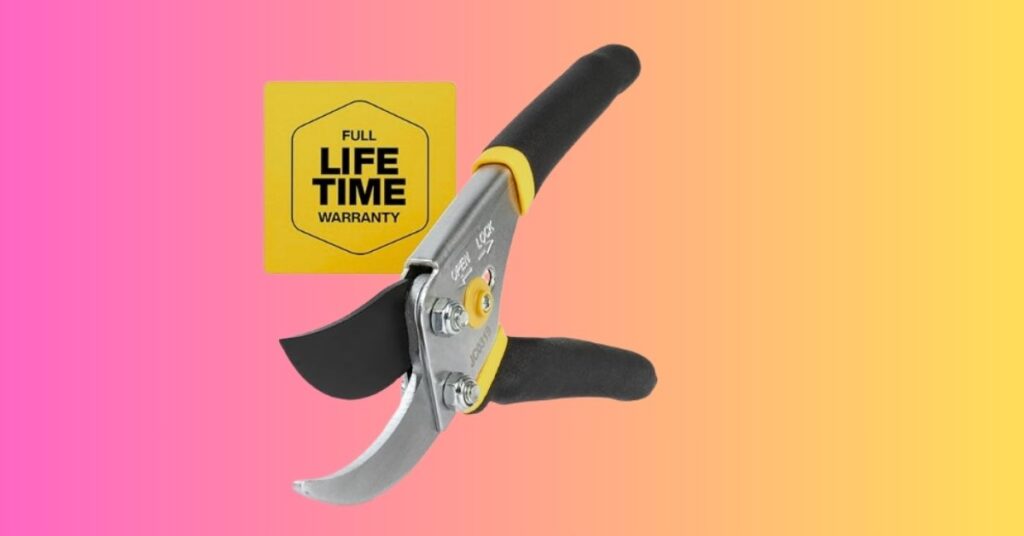
Still comparing options? Our bypass pruner vs garden pruner guide helps you understand the broader landscape of hand pruner types. And if you’re ready to invest in a high-quality pair, our hands-on review of Fiskars bypass pruning shears covers one of the most popular and reliable models on the market today.
What About Forged Pruners?
Forged pruners — made by forging steel under high heat and pressure rather than stamping it — are significantly more durable under hard use, especially when cutting through tough, woody material. If you’re dealing with established shrubs, thicker stems, or high-frequency use, the extra investment in a forged blade pays off in longevity. Read our full breakdown: bypass pruner vs forged pruner — which cuts better and lasts longer?
Always wipe your pruner blades with rubbing alcohol (isopropyl, 70%+) or a 10% bleach solution between plants — especially when removing diseased material. Dirty blades are one of the most common vectors for spreading fungal and bacterial infections throughout a garden.
When to Prune: A Seasonal Guide by Plant Type
Timing is everything in pruning. The single most common mistake — even among experienced gardeners — is pruning spring-blooming shrubs in winter and accidentally removing all the buds. Here is the definitive timing reference:
| Plant Type | Best Time to Prune | Why | Examples |
|---|---|---|---|
| Spring-blooming shrubs | Immediately after flowering | Blooms on “old wood” — winter pruning removes next year’s buds | Lilac, forsythia, azalea, weigela, rhododendron |
| Summer-blooming shrubs | Late winter / early spring | Blooms on “new wood” — pruning stimulates the growth that flowers | Crape myrtle, butterfly bush, rose of Sharon, hydrangea (paniculata) |
| Deciduous trees | Late winter while dormant | No foliage means clear view of structure; rapid wound healing when spring growth begins | Oak, maple, ash, linden |
| Fruit trees | Late winter before budbreak | Maximum view of structure; maximum time to heal before fruit set | Apple, pear, cherry, peach, plum |
| Roses | Late winter / early spring | Just as forsythia blooms is the traditional indicator for rose pruning time | Hybrid tea, floribunda, shrub roses |
| Evergreen shrubs | Late spring (after frost risk) | New growth has hardened; avoids stress during cold snaps | Boxwood, holly, yew, juniper |
| Conifers | Late spring / early summer | “Candle stage” — prune new growth (candles) before they fully extend | Pine, spruce, fir |
| Herbaceous perennials | After flowering or late autumn | Remove spent flower heads; cut back dead foliage before winter | Salvia, phlox, daylily, hosta |
| Fruiting vegetables | Throughout growing season | Removing suckers and excess foliage focuses energy on fruit | Tomatoes, cucumbers, peppers, squash |
Old Wood vs. New Wood — The Most Important Concept in Pruning Timing
Old wood refers to growth from the previous year or earlier seasons. Many spring-blooming plants form their flower buds on old wood during late summer and autumn — those buds overwinter and open in spring. New wood is growth produced in the current season. Summer bloomers typically produce flowers only on growth that emerges after spring pruning stimulates fresh shoots.
Identify which category your plant falls into, and your pruning timing falls into place automatically.
⚠️ Never prune in late summer or early fall for most woody plants. Pruning at this time stimulates a flush of soft new growth that doesn’t have enough time to harden before winter frost. That tender growth gets killed by the first cold snap, opening the plant to disease and dieback.
Pruning Techniques Explained
Before you touch your tools, understand which pruning technique applies to your situation. Using the wrong technique on the right plant still produces poor results.
1. Thinning
Thinning removes entire branches back to their point of origin — either the main trunk, a primary scaffold branch, or the ground. Unlike heading cuts (see below), thinning doesn’t stimulate bushy regrowth; instead it opens up the plant’s interior, improves light penetration, and reduces overall density without changing the plant’s natural form. This is the preferred technique for trees and most mature shrubs.
2. Heading (Pinching / Cutting Back)
Heading cuts remove the end portion of a stem, stopping above a bud or side branch. This directly removes the apical bud (the hormone source for apical dominance), triggering multiple new shoots to emerge from buds below the cut. The result: a fuller, bushier plant. This is the technique used when “cutting back” overgrown shrubs, pinching herbs to keep them leafy, or deadheading flowers to encourage more blooms.
3. Deadheading
Deadheading is the removal of spent flowers before they form seed. When a plant successfully sets seed, it often reduces or stops flower production — its reproduction goal has been achieved. Removing spent flowers tricks the plant into continuing to produce more blooms in pursuit of that goal. For roses, dahlias, cosmos, and many other flowering plants, deadheading is the single most effective way to extend the blooming season dramatically.
4. Coppicing
Coppicing is a drastic technique: cutting all stems of a shrub or small tree back to near ground level (10–15 cm). Traditionally used for woodland management, coppicing is also used in ornamental gardens to maintain shrubs grown for colorful winter stems — like red-twig dogwood and yellow-twig dogwood — in their most vivid, juvenile state. Young stems have the brightest color; coppicing every 2–3 years keeps the display fresh.
5. Rejuvenation Pruning
For severely overgrown shrubs that have lost their vigor and shape over many years, rejuvenation pruning resets the plant. You have two options: the aggressive approach (cutting everything back by two-thirds in one season, acceptable for very resilient species like forsythia and lilac) or the gradual approach (removing one-third of the oldest stems each year for three consecutive years — gentler, lower-risk, and suitable for more delicate species).
6. Pinching
Pinching — literally using your thumb and forefinger to remove the soft growing tip of a young shoot — is a form of heading appropriate for tender plants, herbs, and young annuals. Pinching basil regularly prevents it from going to seed and keeps leaf production high. Pinching young chrysanthemums and petunias creates dense, floriferous plants instead of tall, leggy ones.
How to Prune Plants: Step-by-Step
Follow this systematic approach every time you prune, and you’ll produce consistently excellent results regardless of plant type.
Assemble and Prepare Your Tools
Choose the right tool for the branch sizes you’ll encounter. Sharpen blades if needed (dull blades tear rather than cut). Clean tools with rubbing alcohol. Put on gloves and safety glasses — even a small pruning session produces flying wood chips and sap.
Assess the Plant Before Cutting Anything
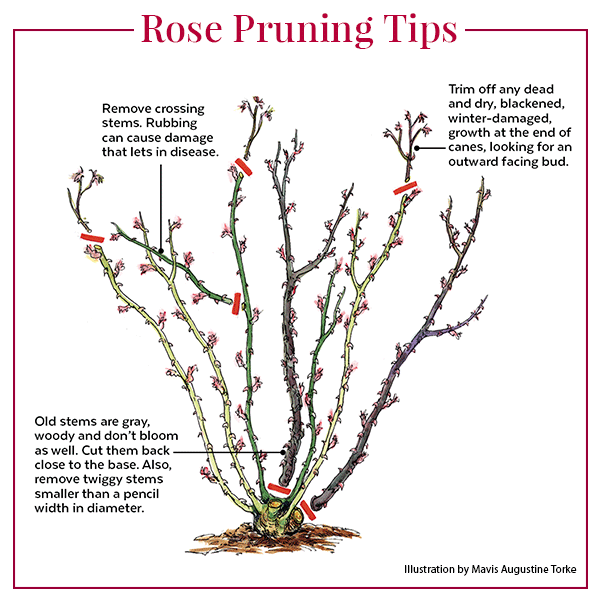
Walk around the plant. Identify the dead, diseased, and damaged wood first. Look for crossing branches, inward-facing growth, and water sprouts. Form a mental picture of the plant’s ideal structure before you make a single cut. Impulsive pruning almost always leads to over-pruning.
Remove Dead, Diseased, and Damaged Wood (The Three D’s)
These are your no-regret cuts. Dead wood is easy to identify: it snaps rather than bends, and the cross-section is brown and dry all the way through. Diseased wood shows discoloration, lesions, or abnormal growth. Cut diseased branches back into clean, white healthy wood — and sterilize your blades between every cut to avoid spreading the pathogen.
Address Crossing, Crowding, and Competing Branches (The Three C’s)
Branches that cross each other rub as they move in wind, creating persistent bark wounds that invite disease. When two branches compete for the same space, remove the weaker or less desirable one at its point of origin. Also remove any branches growing directly toward the center of the plant — they’ll crowd the interior and block light.
Thin the Interior for Light and Airflow
For trees and dense shrubs, selectively remove interior branches to open up the canopy. You’re aiming for a structure where light can penetrate from above — not just reach the outer edges. Stand back periodically and look up through the canopy from below to assess openness.
Shorten and Shape
With structural work done, make your shaping cuts — reducing height or spread, maintaining a formal shape, or cutting back to encourage new growth. Always cut just above a healthy outward-facing bud (see the next section for how to place cuts correctly). The outward-facing bud will grow outward, opening the plant up rather than crowding the center.
Step Back and Evaluate Constantly
After every 3–4 cuts, step back and look at the whole plant. This is the most important habit in pruning. It’s extremely easy to over-prune a single area when you’re focused up close. The golden rule: never remove more than one-third of the plant’s total canopy in a single pruning session.
Clean Up and Dispose of Waste Properly
Collect all pruned material immediately — especially diseased material, which should be bagged and disposed of rather than composted. Leaving cut material under the plant can harbor pests and disease over winter. Oil and clean your tools before storing them.
How to Make the Perfect Pruning Cut
The placement and angle of your pruning cut directly affects how quickly and completely the wound heals. This detail separates good pruning from great pruning.

Cutting Above a Bud: The Rules
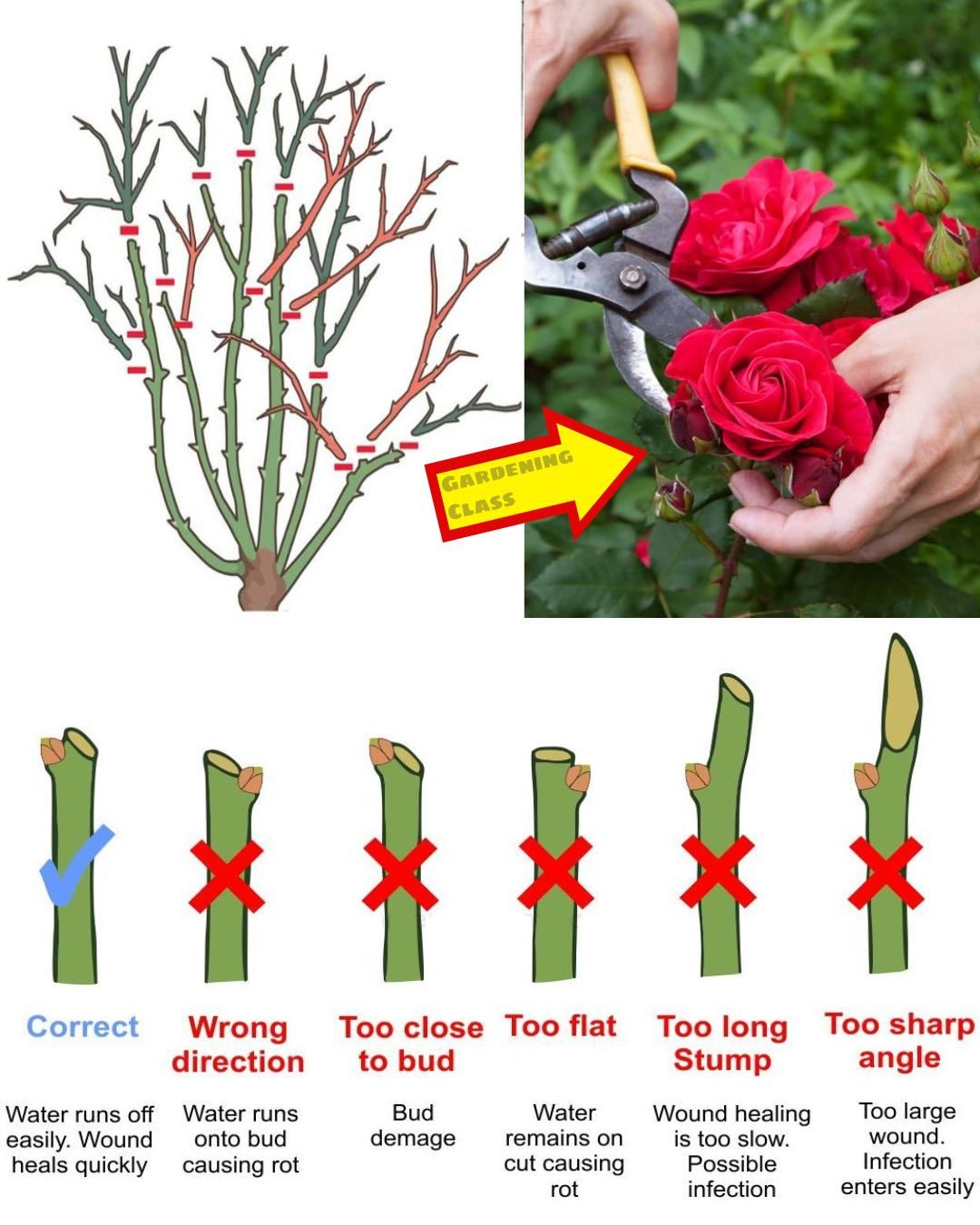
- Distance: Make your cut approximately 3–5mm (about ¼ inch) above the bud. Too close damages the bud; too far leaves a stub that dies back and creates a disease entry point.
- Angle: Cut at approximately a 45-degree angle, sloping away from the bud. This allows rainwater to run off the cut surface rather than pooling on it, which would encourage rot.
- Direction: Always cut to an outward-facing bud (one pointing away from the center of the plant) when you want the new growth to open outward. Cut to an inward-facing bud only on very open plants where additional interior growth is needed.
- Opposite buds: Some plants (maple, ash, dogwood) have buds arranged in opposite pairs on the stem. For these, make a flat, horizontal cut 3–5mm above the pair of buds.
The Three-Cut Technique for Large Branches
For any branch thicker than 1.5 inches, attempting to remove it in a single cut is a serious mistake. The branch’s weight will cause it to tear away before you finish cutting, ripping a long strip of bark from the trunk. This creates a massive, slow-healing wound that becomes a disease highway. Use the three-cut technique instead:
- Undercut: About 12 inches from the trunk, cut upward through approximately one-third of the branch’s diameter. This creates a safety stop that prevents tearing.
- Top cut: About 15 inches from the trunk (slightly further out than the undercut), cut downward through the branch completely. The branch will drop at the undercut point with no tearing.
- Final cut: With the heavy branch now removed, make a clean final cut just outside the branch collar — the slightly swollen ring of tissue where the branch joins the trunk. The collar contains the specialized cells that seal the wound. Never cut the collar away.
For decades, gardeners painted pruning wounds with tar-based sealants. Modern research shows this actually traps moisture and pathogens inside the wound, slowing healing and increasing the risk of rot. Leave wounds clean and exposed — the tree’s own chemistry handles sealing. Just make the cut correctly and let the plant do its work.
Plant-by-Plant Pruning Guide
Different plants have very different pruning requirements. Here’s a focused guide for the most common garden plants:
Roses
Prune in late winter/early spring when forsythia blooms. Cut back to 12–18 inches for hybrid teas. Remove dead canes to the base. Always cut to an outward-facing bud at 45°. Deadhead throughout summer. Our bypass pruner guide lists the best tools for roses.
Fruit Trees
Prune in late winter before budbreak. Remove crossing branches, inward growth, and water sprouts. For apples and pears, maintain a central leader. For stone fruits (peach, plum), develop an open-center vase form. Remove no more than 25% of the canopy per year.
Flowering Shrubs
Spring bloomers (lilac, forsythia): prune immediately after flowering. Summer bloomers (butterfly bush, crape myrtle): prune in late winter. Use the right pruner style for the stem thickness at hand.
Hedges
Shape formal hedges 2–3 times per season using hedge shears. Keep the base slightly wider than the top — this allows sunlight to reach lower branches and prevents the base from going bare over time.
Tomatoes
Remove suckers (shoots growing between the main stem and side branches) regularly to concentrate energy on fruit. For indeterminate varieties, maintain 1–2 main stems. Top the plant 2–3 weeks before your first expected frost to trigger final fruit ripening.
Herbs
Pinch basil, mint, and cilantro regularly to prevent flowering (bolting) and encourage dense, leafy growth. Cut lavender back by about one-third after flowering — never into old, woody stems with no green growth, as lavender does not regenerate from bare wood.
Trees (Ornamental)
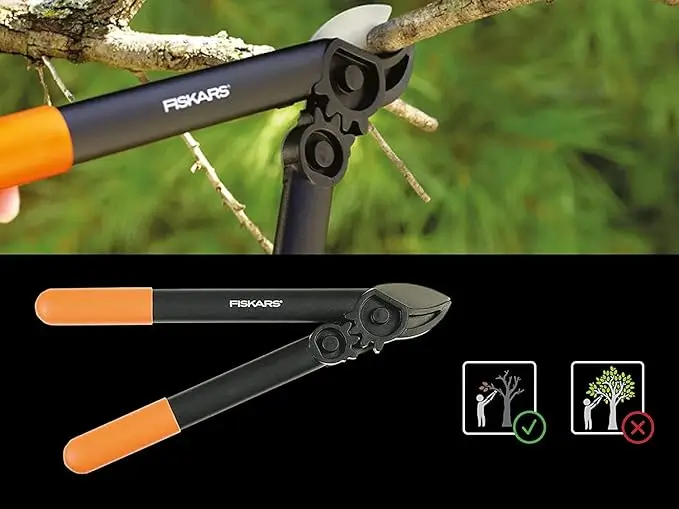
Prune most deciduous ornamental trees in late winter while dormant. Remove the Three D’s first, then crossing branches, then thin for airflow. Use the three-cut technique for any branch over 1.5 inches thick. For larger trees, the Fiskars 2-piece tree care set handles most homeowner-scale tree work.
Hydrangeas
Pruning timing varies by species. H. paniculata and H. arborescens (including Annabelle): prune in late winter/early spring — they bloom on new wood. H. macrophylla (big leaf, blue/pink): prune immediately after flowering — they bloom on old wood. Pruning them in winter eliminates the following summer’s blooms.
Common Pruning Mistakes to Avoid
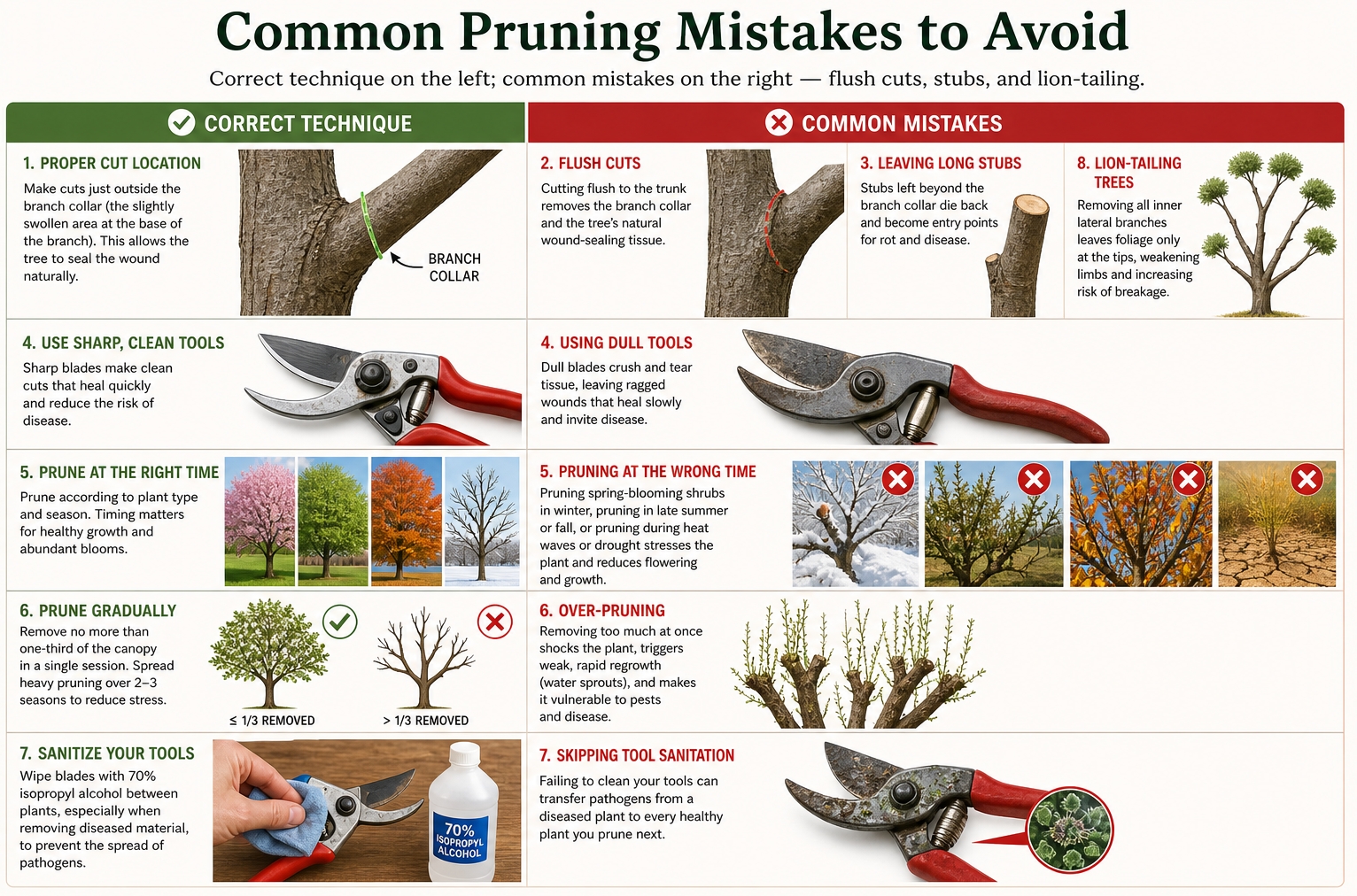
- Topping trees: Cutting the entire crown off a tree (“topping” or “hat-racking”) is among the most damaging practices in gardening. It destroys the tree’s structural integrity, triggers an explosion of weak, fast-growing epicormic shoots, permanently deforms the canopy, and dramatically shortens the tree’s life. Never do this for any reason.
- Flush cuts: Cutting flush to the trunk removes the branch collar — the slightly swollen ring of protective tissue at the branch base. The collar contains specialized cells that rapidly seal the wound. Remove it, and the tree loses its primary wound-sealing mechanism. Always cut just outside the collar, leaving it intact.
- Leaving long stubs: The opposite of a flush cut. A stub left projecting beyond the branch collar can’t be sealed by the tree — it dies back progressively toward the trunk, and that dying stub becomes an ongoing entry point for rot and disease.
- Using dull tools: Dull blades compress and tear plant tissue instead of slicing cleanly. The result is a ragged wound with bruised, damaged tissue around the edges — much slower to heal and more vulnerable to infection. Keep your pruners sharp. Our full guide to sharpening pruning shears walks through every step.
- Pruning at the wrong time: Pruning spring-blooming shrubs in winter, pruning in late summer or fall, or pruning during a heat wave or drought. Timing matters enormously — refer to the seasonal guide above.
- Over-pruning in a single session: Removing more than one-third of the canopy at once severely stresses the plant. It triggers a panic response: rapid, weak regrowth (called “water sprouts” on trees), diversion of stored energy reserves, and temporary vulnerability to pests and disease. If a plant needs heavy renovation, spread the work over 2–3 seasons.
- Skipping tool sanitation: A single pass with a diseased branch can coat your blades in pathogens that then infect every subsequent plant you touch. Wipe blades with 70% isopropyl alcohol between plants — especially when removing diseased material.
- “Lion-tailing” trees: Removing all the inner lateral branches from main limbs, leaving foliage only at the very tips (like a lion’s tail). This weakens the mechanical structure of the limb significantly, making it far more likely to snap in wind or under snow load.
Frequently Asked Questions About Pruning Plants
It’s best to avoid pruning on wet days when possible. Wet conditions promote the rapid spread of fungal spores, which can enter fresh pruning wounds much more easily than in dry conditions. If you must prune after rain, ensure your tools are sterilized and allow the wounds to dry as quickly as possible.
The widely accepted guideline is to remove no more than one-third of the total canopy in a single pruning session. Going beyond this significantly stresses the plant. If a plant requires heavy renovation, spread the pruning over two to three seasons rather than trying to fix everything at once.
Pruning is generally very safe, and most healthy plants recover readily from pruning — even aggressive pruning. The most common cause of pruning-related plant death is cutting at completely the wrong time (e.g., pruning a tender plant just before a hard frost), severe over-pruning of an already-stressed plant, or introducing disease via unsanitized tools. Follow the seasonal timing guide and keep your tools clean, and pruning-related fatalities are extremely rare.
No. Modern horticultural research consistently shows that wound sealants are unnecessary and often counterproductive — they can trap moisture and pathogens inside the wound. Healthy trees and shrubs produce their own callus tissue that seals pruning wounds effectively. Just make a clean, correct cut and let the plant handle the rest.
In casual usage these words are often used interchangeably, but there is a meaningful distinction: pruning refers to targeted, deliberate removal of specific branches, stems, or buds to improve plant health and structure. Trimming typically refers to light, surface-level shaping — such as running hedge shears along the outside of a box hedge. Pruning is structural; trimming is aesthetic.
It depends on the species. Hydrangeas that bloom on old wood (like most H. macrophylla — the common blue and pink varieties) should be pruned immediately after flowering in late summer. Hydrangeas that bloom on new wood (H. paniculata like Limelight, and H. arborescens like Annabelle) can be pruned in late winter or early spring.
For a beginner, a quality bypass hand pruner is the best starting point — it handles the vast majority of garden pruning tasks and is easy to use. The Fiskars bypass pruning shears are consistently recommended for beginners: durable, comfortable, and sharpenable. If you want to compare several top-rated models before buying, see our bypass pruner reviews for tested recommendations across different budgets.
Minimal pruning is recommended for newly planted trees and shrubs in their first year. Remove dead, damaged, or diseased branches, but avoid heavy structural pruning until the plant has established its root system — typically 1–2 years after planting. Give the plant time to settle and redirect its energy into root development before asking it to handle significant pruning stress as well.
Quick Pruning Reference Checklist
- Tools are sharp, clean, and sanitized before starting
- You know whether your plant blooms on old wood or new wood
- You’ve assessed the whole plant before making any cuts
- Dead, diseased, and damaged wood is removed first
- Crossing and rubbing branches have been addressed
- Interior canopy has been thinned for light and airflow
- All cuts are made just above an outward-facing bud at 45°
- Branch collar is left intact on all tree cuts
- No more than one-third of the canopy removed total
- Diseased material bagged and disposed of (not composted)
- Tools cleaned, oiled, and stored after use
Final Thoughts: Pruning Is a Skill Worth Mastering
Pruning is not a chore to be feared — it’s one of the most satisfying and impactful things you can do for your garden. Once you understand the science behind why plants respond the way they do, and once you have a reliable set of sharp, quality tools in your hands, pruning transforms from a stressful uncertainty into a confident, creative act of garden stewardship.
Start simple: remove dead and diseased wood first, always. Build your confidence on shrubs before moving to trees. And invest in at least one genuinely quality pruner — our tested bypass pruner reviews will help you find the right one for your budget. If you’re brand new to choosing pruners, our complete bypass pruner guide for gardeners covers everything from blade types to grip ergonomics.
For larger tree work, consider the Fiskars 2-piece tree care set — it pairs a high-quality pruner with a saw and handles the majority of homeowner-scale tree trimming without needing professional help. Your plants will reward every well-placed cut with stronger growth, better blooms, and longer, healthier lives.